The Load Behind the Label: Auditing Efficiency Claims Before a UK Motor Retrofit
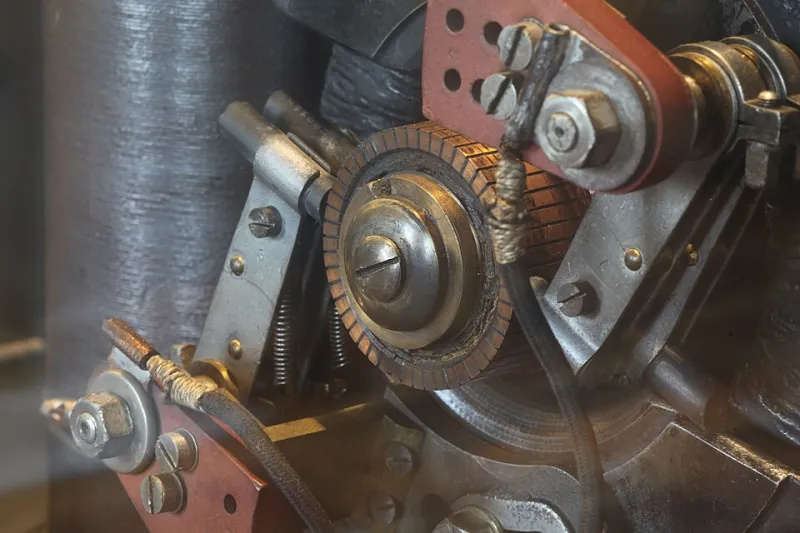
Photo: Rama, CC BY-SA 3.0 fr, via Wikimedia Commons
Efficiency class has become procurement shorthand. A quotation arrives with IE4 against the motor line, the sustainability annexe of the business case writes itself, and the retrofit is signed off. Yet the class printed on the rating plate describes performance at a single point — rated load, rated voltage, rated frequency — measured under the reference conditions defined in IEC 60034-30-1. It says remarkably little about the point at which the motor will actually run: a plant room at 42 °C in August, driving a pump that was throttled to balance a circuit sometime in the 1990s.
That gap between the label and the load is where retrofit business cases quietly fail. The purpose of this article is not to argue against high-efficiency motors. It is to argue that the class designation should be the last item examined, not the first.
What the nameplate genuinely promises
The IE classification is a comparison tool. It sets a minimum efficiency at rated output for a defined frame range, tested to a harmonised method. A 15 kW IE4 machine will, on a calibrated dynamometer at nominal voltage and frequency, better the efficiency of its IE3 equivalent by a margin measured in one or two percentage points. That is a real and repeatable gain.
What the label does not tell you is how that margin behaves at 35 % load, or after a decade in a dusty enclosure, or when the supply is 4 % unbalanced on one phase. Efficiency curves fall away steeply below roughly half load, and the fall is not identical across designs. Two motors of the same class can differ materially at the duty point you actually occupy.
Two failure modes worth naming
The first is oversizing. Motors are frequently specified with a generous margin — for starting torque, for a future duty increase, or simply because that was the next frame up. A machine sized for 100 % and run at 28 % is operating where magnetising current dominates and power factor sags. Replacing a well-matched IE3 motor with an oversized IE4 unit can leave you with a marginally better headline number and a worse real-world outcome.
The second is misapplication. On centrifugal pumps and fans, absorbed power follows the cube of speed. If the process is currently regulated by a throttle valve or a damper, the efficiency conversation is being held in the wrong room: the losses are hydraulic or aerodynamic, not electromagnetic. No class of motor recovers them. Where a variable-speed drive is not present, the strongest efficiency case may well be the drive rather than the motor — and where a drive already exists, the motor change alone may deliver less than the business case assumes.
Stage one: define the duty before anyone quotes
Start with the process, not the asset register. Establish flow and head, or volumetric rate and static pressure, at the points the plant actually visits across a week — including the night set-back and the weekend minimum. If a pump curve exists, plot the measured operating point against it. If the machine is being throttled, quantify the pressure drop being thrown away.
This stage costs a day of technician time and routinely reshapes the project. It is also the stage most often skipped when a quotation has already been circulated.
Stage two: measure input power, not output
Input power is measurable; shaft output is not, at least not without a torque transducer and an outage. A three-phase power analyser of at least class 1 accuracy, logging true power, apparent power, power factor and voltage total harmonic distortion at five-minute intervals across a representative week, gives you the evidence base. Decide in advance whether you are logging at the motor terminals or at the MCC — cable losses belong to one or the other, and the report should say which.
Be honest about uncertainty. A measurement chain with 2 % uncertainty will swamp a one-and-a-half point efficiency difference. Repeatability and documented instrument calibration matter more here than the number of decimal places in the spreadsheet.
Stage three: weight by time, not by peak
Convert the log into a load profile: percentage of running hours spent in bands of, say, 0–25 %, 25–50 %, 50–75 % and 75–100 % of rated output. Then compare candidate motors on time-weighted efficiency, using each manufacturer's part-load data rather than the single class figure. This is the step that converts a marketing claim into a defensible number, and it is the step that most often exposes an oversized incumbent.
Where half-hourly metered data exists for the building, reconcile the two. Discrepancies usually reveal an unmetered load or an operating-hours assumption that was optimistic by a night shift.
Stage four: interrogate the drive, if there is one
On VSD-fed machines, the drive is already an instrument. Speed reference, output current, DC bus voltage and, on many platforms, estimated torque or power are available without additional hardware. Trend them across the same week. If the drive is running at 92 % of nominal speed on a centrifugal duty, the case for speed reduction is likely stronger than the case for a motor swap — and the two should be evaluated together, not sequentially.
Drive data also exposes the awkward cases: motors run at fixed speed on a drive purely for soft starting, where the drive losses offset much of the motor gain.
Stage five: price the whole change
Include the ancillary effects. Higher-efficiency frames often have different inertia and starting characteristics; check compatibility with existing direct-on-line starting, protection settings and cable sizing under BS 7671. Check shaft height and flange dimensions against the driven machine. Check whether the enclosure rating still suits a washdown area. Add the cost of alignment, coupling work and downtime.
Finally, build the payback on realistic running hours and the measured profile, with a sensitivity case for a 20 % shortfall in hours. If the case only survives at the optimistic end, it is not yet a case.
The verdict
IE4 is a worthwhile destination, but the class is a claim about a point, not a promise about a plant. Ask suppliers for part-load data at your measured duty, insist on a load profile before the quotation is finalised, and treat the efficiency class as the conclusion of the audit rather than its opening line. Retrofit capital is scarce; the discipline of measurement is what makes it land in the right place.