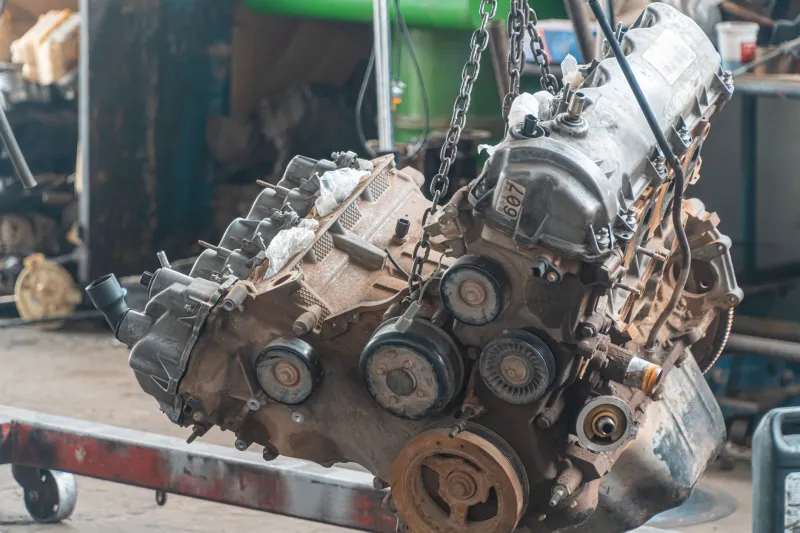
The Ageing Motor Verdict: Rewind, Replace or Retrofit With the Numbers in View
Photo: Rama, CC BY-SA 3.0 fr, via Wikimedia Commons
An ageing motor rarely fails at a convenient moment. The production line is down, the stores team is searching for a spare, and the first quotation is often accepted before anyone has calculated the true cost of each route. For UK plants running Bosch motors, the decision between rewind, replacement and retrofit deserves a short, disciplined review rather than an emergency judgement.
Start with the duty, not the failure
Before asking for prices, collect the facts that will drive the decision. Record the nameplate data, IEC frame size, mounting arrangement, shaft extension, flange dimensions, encoder or brake fitment, terminal box position and cooling method. Add the measured running hours, load profile, start frequency, ambient conditions and failure history. If the motor is on a critical duty, note the contribution lost per hour of stoppage. That single figure often changes the answer more than the repair quotation does.
For a Bosch motor, also check whether the drive retains the original commissioning parameters, motor model data and thermal settings. A replacement motor that is mechanically interchangeable may still need drive parameter changes, encoder alignment and EMC checks. Those engineering hours belong in the comparison.
The three routes in plain terms
A rewind restores the stator winding and usually replaces bearings, seals and wear parts. It is often the lowest-cash option and can be quick if a reputable workshop has capacity. The limits are equally clear: a rewind restores the motor to approximately its original design, not to a higher efficiency class. Core loss, insulation performance and mechanical condition must be assessed. For hazardous-area, washdown or specialist machines, rewind may affect certification or warranty unless it is handled by an approved route.
A replacement means a new IE4 or IE5 motor, or a like-for-like modern frame where the duty demands it. The purchase price is higher, and lead times of four to twelve weeks are common for non-stock frames. The rewards are higher efficiency, a clean warranty and known starting torque characteristics. The risk is interface mismatch: shaft height, flange pilot, keyway, terminal box, encoder, brake, weight and cooling clearance all need checking before the old motor is removed.
A retrofit is the widest scope. It may mean a new motor plus a variable speed drive, a revised control panel, new cabling or a re-engineered mounting arrangement. It costs the most and takes the longest, but it can deliver controllability, soft starting, speed optimisation and better energy data. Retrofit is most defensible when the process itself can benefit from speed control, not simply when the old motor has failed.
A worked comparison for a 30 kW duty
Take a 30 kW, four-pole Bosch motor running 4,000 hours a year on a UK site. Assume the existing machine is roughly IE2 efficiency, the rewind quotation is £2,200 with a ten-working-day turnaround, a new IE4 frame is £4,800 with an eight-week lead time, and a motor-plus-drive retrofit is £8,500 with a ten-week programme. Use an electricity price of £0.24/kWh for the 2026 comparison.
At 30 kW output, an IE2 motor at about 91.0% efficiency draws roughly 32.97 kW. An IE4 motor at about 93.6% draws roughly 32.05 kW. The difference is about 0.92 kW, or 3,680 kWh a year at 4,000 hours. At £0.24/kWh, that is about £883 a year. Against a rewind, the new IE4 motor carries a £2,600 capital premium before installation and drive changes, so the energy payback is roughly three years on this duty alone. If the motor runs 6,000 hours a year, the case improves quickly; if it runs 800 hours a year, it weakens.
Downtime can overwhelm those figures. If the line cannot run without the motor, ten working days at eight production hours and £1,200 per hour of lost contribution is £96,000. An eight-week replacement without a temporary motor would be far worse. That does not prove replacement is wrong; it proves that spares, rental motors or temporary drives must be part of the plan. The cheapest quotation is not the lowest-cost outcome if it extends stoppage.
Decision rules that hold up under scrutiny
- Rewind first when the stator is the only damaged item. If the core, shaft, frame and certification status are sound, and the motor is non-critical or lightly loaded, a quality rewind can be rational. Ask for surge testing, insulation resistance, no-load running, vibration checks and a clear warranty.
- Replace when efficiency and reliability carry the case. Motors older than fifteen years, IE2 or below, running more than 3,000 hours a year, are usually strong replacement candidates. The new frame should be checked for mechanical interchangeability before order placement.
- Retrofit when the process needs control. If the duty is throttled by a valve, damper or clutch, a drive-led retrofit may save more than the motor replacement alone. Model the load profile before assuming a drive will help.
- Do not let an unusual frame force a false economy. A non-standard shaft, flange or brake can make a new motor expensive to fit. Compare the fully installed cost, not the motor price.
Questions to ask before committing
Is the rewind carried out to a recognised standard, and does it preserve any hazardous-area or washdown certification? Will the motor be re-tested at full load, or only at no load? Is the replacement frame dimensionally identical, including shaft end, flange pilot and terminal box? Does the existing Bosch drive accept the new motor data, encoder type and thermal model? What is the realistic lead time, and what temporary arrangement covers the gap? Finally, has the energy saving been based on measured hours and load, or only on nameplate efficiency?
A motor failure is a maintenance event, but the choice between rewind, replacement and retrofit is an asset decision. Gather the duty data, put downtime and energy into the same comparison, and the verdict is usually easier to defend.